Free Potted Crocus Crochet Pattern Beginner Friendly
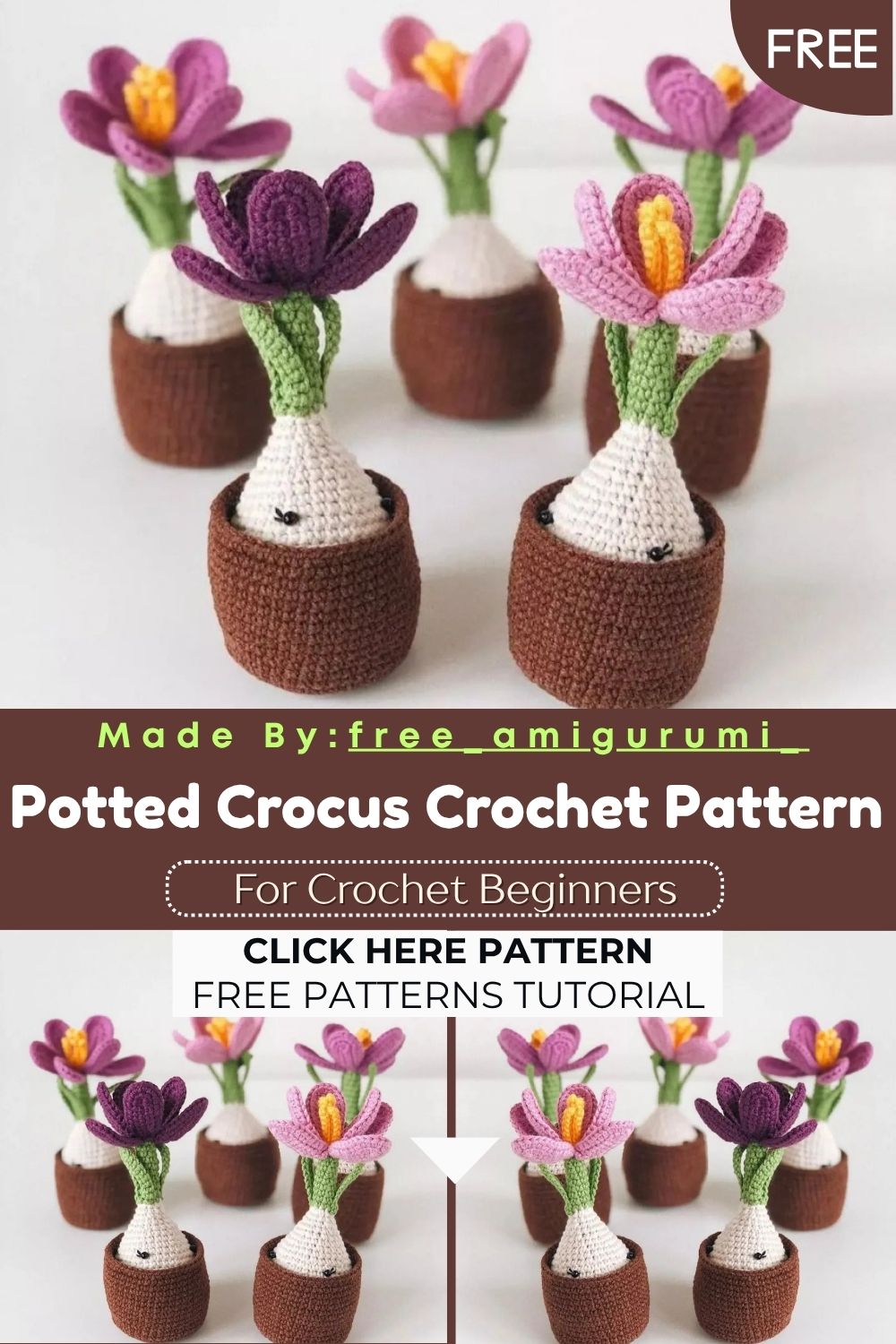
Six lilac petals, a bright yellow stamen, three green leaves, and a cheerful face on the bulb. This crocus in a pot is the most complete crochet plant scene you will ever make!
Most crochet flower patterns give you just the bloom and call it done. This one builds an entire scene. The bulb has a face and transitions seamlessly into a green stem. Six separate petals wrap around it in two overlapping layers. A delicate two-part stamen sits at the center. Three leaves of different lengths fan out from the sides. And the whole thing sits inside a brown crocheted pot that is sturdy enough to hold its shape on any shelf.
Every piece is distinct and builds on the last. Together, they create a finished crocus plant that genuinely looks like something you would find in a specialist gift shop.
Skill Level
Beginner to intermediate. Standard increases and decreases carry the bulb and pot construction. Additionally, the petal foundation chain, the two-part stamen, and the graduated leaf lengths each introduce quick new techniques that are easy to follow once read through carefully.
Materials You Will Need
Yarn:
- Yarn Art Jeans — milk (No. 05) for the bulb
- Yarn Art Jeans — green (No. 69) for the stem and leaves
- Yarn Art Jeans — lilac (No. 65) for the petals
- Gazzal Baby Cotton — yellow (No. 3417) for the stamens
- Alize Cotton Gold — brown (No. 493) for the pot
Other Supplies:
- Crochet hooks 2mm and 1.7mm (or suitable size for your yarn)
- Amigurumi stuffing
- Black and burgundy embroidery floss for eyelashes and mouth
- Bead eyes – 3mm (1 pair)
- Sewing needle
- Pins
- Scissors
Abbreviations
- MR — Magic Ring
- CH — Chain
- SC — Single Crochet
- INC — Increase (2 sc in one loop)
- DEC — Decrease (2 stitches together)
- STS — Stitch(es)
- SLST — Slip Stitch
- HDC — Half Double Crochet
- (…) x — Repeat in brackets the stated number of times
- (…) — Total stitch count at end of round
Pattern: Bulb and Stem
Using milk colored yarn
Row 1: 6 sc in MR (6) Row 2: inc x6 (12) Row 3: (sc, inc) x6 (18) Row 4: (2sc, inc) x6 (24) Row 5: (3sc, inc) x6 (30) Row 6: (4sc, inc) x6 (36) Row 7: (5sc, inc) x6 (42) Rows 8–14: 42 sc for 7 rounds (42)
Stuff as you crochet through these straight rounds.
Row 15: (5sc, dec) x6 (36) Row 16: 36 sc (36) Row 17: (4sc, dec) x6 (30) Row 18: 30 sc (30) Row 19: (3sc, dec) x6 (24) Row 20: 24 sc (24) Row 21: (2sc, dec) x6 (18) Row 22: 18 sc (18) Row 23: (sc, dec) x6 (12) Row 24: 12 sc (12) Row 25: (2sc, dec) x3 (9)
Sew the bead eyes between rows 15 and 16, approximately 8 stitches apart. Embroider the lashes above each eye using black embroidery floss. Embroider the mouth at row 13 using burgundy floss. Add blush if desired.
Switch to green yarn for the stem.
Rows 26–28: 9 sc for 3 rounds (9) Row 29: dec, 7 sc (8) Rows 30–32: 8 sc for 3 rounds (8) Row 33: dec, 6 sc (7) Rows 34–35: 7 sc, slst (7)
Stuff lightly. Cut and secure the thread.
Pattern: Petals Make 6
Using lilac yarn
Chain 10. Starting in the second chain from the hook:
Row 1: 2 sc, 6 hdc, 5 hdc in one loop, 6 hdc, 2 sc, slst in turning chain (22)
Row 2: slst, 3 sc, 4 hdc, (inc) x5, 4 hdc, 3 sc, 2 slst (27)
Cut the thread leaving approximately 9cm for sewing.
The five increases at the rounded tip of each petal create the natural soft curve that makes each one look like a real crocus petal.
Pattern: Stamens
Using yellow yarn
Part 1: Chain 8. Starting from the second chain: 7 slst, ch8, 7 slst, ch8, 7 slst.
Cut the thread leaving approximately 15cm for sewing.
Part 2: Leaving a 20cm tail, work:
Row 1: 2 ch, 5 hdc in MR, slst (5) Row 2: (2ch, slst) x5
Cut and secure the thread.
Using the remaining 20cm tail, make the first loop in the magic ring. Chain 6 then work 5 slst in the second chain from the hook. Cut the thread and weave in the shorter end to close any gaps.
Sew both stamen parts together with part 2 positioned in the center of part 1. Sew the center first then the outer sections. Attach the assembled stamen to the top of the stem, stitching only through the inner loops of the stem top.
Pattern: Leaves
Using green yarn
Leaf 1 (longest): Chain 16. Starting from the second chain: slst, 14 sc. Cut yarn leaving enough for sewing.
Leaf 2 (medium): Chain 14. Starting from the second chain: slst, 12 sc. Cut yarn leaving enough for sewing.
Leaf 3 (shortest): Chain 12. Starting from the second chain: slst, 10 sc. Cut yarn leaving enough for sewing.
The three different lengths create a natural, organic leaf arrangement that fans out from the stem without looking identical or uniform.
Pattern: Pot
Using brown yarn
Row 1: 6 sc in MR (6) Row 2: inc x6 (12) Row 3: (sc, inc) x6 (18) Row 4: (2sc, inc) x6 (24) Row 5: (3sc, inc) x6 (30) Row 6: (4sc, inc) x6 (36) Row 7: (5sc, inc) x6 (42) Row 8: Back loops only — 42 sc (42)
The back loop only round creates the clean ridge that forms the base of the pot walls.
Rows 9–10: 42 sc for 2 rounds (42) Row 11: (6sc, inc) x6 (48) Rows 12–21: 48 sc, slst for 10 rounds (48)
Cut and secure the thread. The slightly wider top at row 11 gives the pot a natural flared rim that mimics a real terracotta planter.
Assembly
Stamens: Sew both stamen pieces together first. Place part 2 at the center of part 1. Sew the center connection then the outer edges. Attach to the stem top through inner loops only.
Petals first layer: Outline three petal positions in a triangle shape around the bulb and mark with pins. Sew these three petals with the tips facing upward rather than downward. This is important for the correct crocus flower appearance.
Petals’ second layer: Place the remaining three petals between the first three and sew in the same manner. The overlapping two-layer arrangement creates the full, dimensional crocus bloom.
Leaves: Place all three leaves face-to-face with the stem and pin before sewing. Stitch not just at the very base but also slightly higher up each leaf so they hold their position securely when displayed.
Pot: Insert the assembled crocus plant into the brown pot and secure the stem base inside.
Customization and Variation Ideas
- First, swap the lilac petals for deep purple or soft white for a completely different crocus variety using the same petal construction.
- Additionally, make a trio of crocus plants in three different petal colors and display them together as a miniature flower garden.
- Moreover, add extra leaves up to five or six for a fuller, more lush plant arrangement that fills the pot more generously.
- Furthermore, try the pot in terracotta orange instead of brown for a more realistic clay pot appearance that suits earthy home décor perfectly.
- Also, skip the face on the bulb entirely for a purely botanical version without character features for a more minimalist decorative aesthetic.
- Finally, make the bulb in a light yellow or cream color for a daffodil-inspired variation by pairing it with yellow petals and an orange stamen center.
Common Mistakes to Avoid
- First, working row 8 of the pot in both loops instead of back loop only: This round creates the ridge that separates the pot base from the walls. Working both loops removes this essential structural detail.
- Additionally, sewing petals facing downward: The pattern specifically instructs petals to face upward when sewn on. Downward-facing petals create a drooping, closed flower effect rather than the open crocus bloom the pattern intends.
- Also, assembling the stamen without the two parts connected first: Sew both stamen parts together before attaching to the stem. Attaching each part separately makes the finished stamen look flat and unstructured.
- Furthermore, sewing leaves only at the base: The leaves need stitching at both the base and slightly above to prevent them from falling away from the stem with gentle handling.
- Moreover, placing eyes too early or too late: Eyes go between rows 15 and 16, during the decrease section. Mark the position with pins and check from directly in front before pushing the bead through permanently.
- Finally, cutting the petal sewing tail too short: Leave approximately 9cm as instructed. A shorter tail makes securing the petals firmly to the bulb significantly more difficult.
Finishing Tips
- First, when sewing the first three petals, check their spacing carefully from above before committing to final stitches. Even triangle spacing between the first layer creates the foundation for the whole flower arrangement.
- Additionally, after assembling the stamens, gently fluff and separate the yellow chain loops with a tapestry needle before attaching to the stem for maximum visual detail.
- Moreover, press each leaf lightly between your fingers after completing it to encourage the sc stitches to lie flat and even before sewing onto the stem.
- Furthermore, when inserting the crocus assembly into the pot, add a small amount of stuffing inside the pot base first. This lifts the stem slightly and creates a more natural, soil-filled appearance.
- Also, photograph the finished crocus pot beside a real plant or on a windowsill with natural light coming from one side for the most flattering and appealing presentation.
- Finally, weave in every yarn end through at least three direction changes before trimming. Fine cotton-blend yarn unravels more easily than acrylic and needs thorough securing at all end points.
Gifting Ideas
- First, present the finished crocus pot wrapped in a square of linen fabric tied with twine for a rustic, handmade gift presentation that feels genuinely considered.
- Additionally, pair with a small packet of real crocus bulbs for a gardening-themed gift that connects the handmade piece to its natural inspiration.
- Moreover, these make wonderful spring birthday gifts, housewarming presents, and teacher appreciation gifts. The potted plant format means they suit almost any recipient and any home aesthetic.
- Furthermore, make a matching set of three pots in purple, white, and yellow and present them together as a complete early spring garden scene.
- Also, attach a handwritten care card that playfully describes the watering schedule never, and the repotting frequency also never, for a gift detail that always gets a warm response.
- Finally, these sell consistently well at spring craft markets where the combination of a recognizable plant, a character face, and a complete scene creates genuine standout appeal beside more standard amigurumi offerings.
Conclusion
This crocus pattern is genuinely one of the most complete crochet plant projects available at this level. The way the bulb, stem, petals, stamens, leaves, and pot all come together into a single cohesive scene is what separates it from most flower patterns. Therefore, pin the petals in position before sewing, stitch the leaves at two points rather than one, and take your time assembling the stamen before it goes anywhere near the stem. In conclusion, this little crocus is ready to bloom on any shelf it finds itself on.
Happy crocheting! Cannot wait to see your crocus pot come to life.